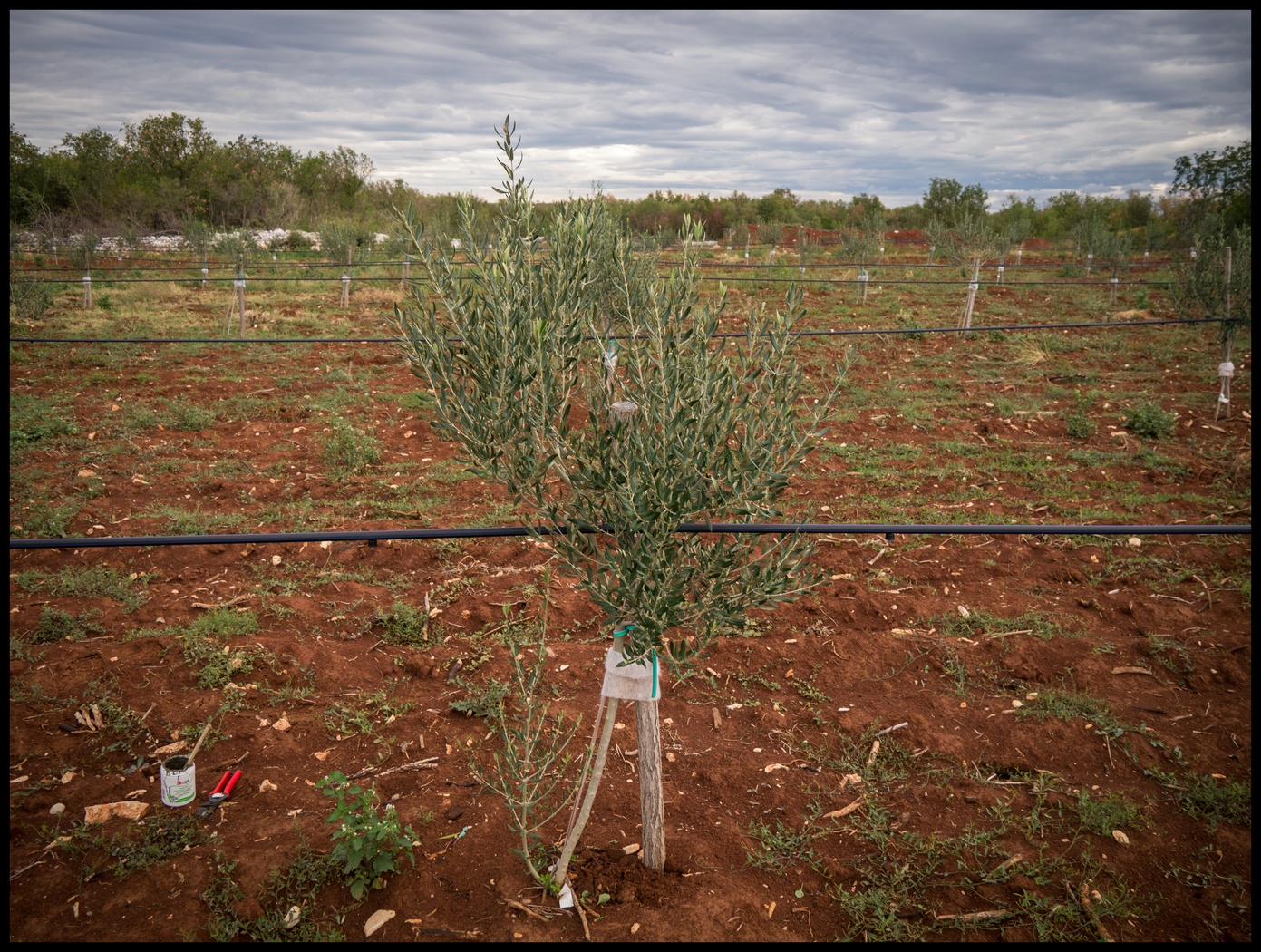
She's cold, she's strong, and she's coming from the northeast. Some say she was born in the vastness of Siberia, and judging by her fierce gusts and biting coldness, it may as well be. It is the bora, the menace of our windrose.
The coldness, if she endures for more weeks, can freeze quite old trees, let alone the young ones. The gusts can take their toll on branches, and even eradicate trees. We had the first preview few days ago, and a torough check of the young tress and their supporting poles had to be done.
So far so good, a lotta shaking going on but no damage. Some tying up to be done here and there, but mostly small issues.
Since pictures in this case may not be descriptive enough, here are two short videos made during the control walk:
Good fun for sailing, not so much in the orchard!
Monday, 19 November 2012
Monday, 12 November 2012
The olive autumn
As one would expect, autumn brings a certain slowdown to the activities in the orchard, however not of the magnitude that would ensure a boring time to yours truly. The plants are still growing and pruning is still on the to do list, and there is a number of other things that need to be taken care of. Therefore I am quite neglecting to update you in the last few days, but here is part of what I promise to give you in the forthcoming days and weeks:
- an insight on the wind influence on the young plants
- a report on our latest try to minimize the negative influence of the insects I've been speaking about here
- some statistics and a field report on another enemy of ours
- last but not least, a preview of our logo, bottle, and label(s)!
Stay tuned!
Tuesday, 30 October 2012
An evening at the oil mill
The autumn days have their specific scents, with one giving berth to the other, each year, with the same regularity and predictability. It all starts with the southern winds bringing the humidity and saltiness much needed after the dry summer, perfumed by the flowering origano, lavender and pinetrees. The first autumn scents to take over the streets of my town are those of the fermenting grapes, later replaced by the bitter odour of the grape pomace during the grappa production. Later, at the time when the first chimneys awake after the long pause, and the burning wood slowly but persistently permeate each corner of the town, the olive oil mills come back to life with their dimmed sound, and the bitter smell of crushed olives takes control for several months. In the evening, sun already fallen, one would expect a small province town to fall even to quieter existance than usual. But it is then that the oil mills burst into life, with tens of vehicles bringing the harvest of the day, and many more passers by stopping and inquiring about who picked which cultivar, and check the looks and quality of the olives, all good starting points for a bit of conversation and why not, a glass of wine.
For some (to me) unfathomable reason, my 3 year old daughter is fascinated by the oil mills, so each walk we take in the evenings has to stop at one of the mills, where for about one hour she checks every stage of oil production, from the olives and their looks, to the taste of the final product. No need to say she is already a habitue' of our mills, promptly greeted by the mill workers. Which brings me to a necessary apology: the pictures that follow were taken with my daughter in one hand, and a pretty poor lightning, but anyway will give you an idea how the olives are processed and the olive oil is made.
For those inclined in a more technical explanation, look here. I will follow up more in detail on oil mills later.
For some (to me) unfathomable reason, my 3 year old daughter is fascinated by the oil mills, so each walk we take in the evenings has to stop at one of the mills, where for about one hour she checks every stage of oil production, from the olives and their looks, to the taste of the final product. No need to say she is already a habitue' of our mills, promptly greeted by the mill workers. Which brings me to a necessary apology: the pictures that follow were taken with my daughter in one hand, and a pretty poor lightning, but anyway will give you an idea how the olives are processed and the olive oil is made.
![]() |
| Olives (bianchera, busa, leccino) stored in a 400kg box, waiting to be processed |
![]() |
| Another box, probaby frantoio, looking at the colour and shape |
![]() |
| And yet another, here we see the fruits of the bianchera cultivar |
![]() |
| First stage: the olives start the process by being feeded to the washer |
![]() |
| Empty feeder (with my daughter, we always have to wait here until empty...) |
![]() |
| Washing time: the green shadows above the water are actually olives falling in the pool) |
![]() |
| Nice and clean, the olives move on to the crusher |
![]() |
| It may not look as much, but here is where the olives get crushed in a green/brown pulp |
![]() |
| This is where the oil extraction takes place. The pulp is continuously mixed until... |
![]() |
| ...after filtering and separation, the oil makes the first appearance! |
For those inclined in a more technical explanation, look here. I will follow up more in detail on oil mills later.
Labels:
olive oil
Friday, 26 October 2012
A harvest day
In the old times, speaking of olive harvest would bring to memory pictures of cold, wet, windy winter days spent picking olives either from tall tress, balancing on wooden ladders, or back-aching bent over the ground to pick the fallen ones. Frozen hands, painfully sensitive ears and noses tickled by the thin branches and hardened leaves.
As all things in life develop and change, so did also the logic of cultivation of olives and production of oil. No more tall trees to allow crops to grow in their shade, or late harvest to achieve the highest oil percentage at the mill*. The trees are kept lower to ease hand picking, and the olives are picked at the best time that enables to maintain the polyphenols high and produce the best quality olive oil.
Last Sunday was a truly beautiful autumn day, quiet and peaceful, one could almost feel the nature preparing for the winter rest and soaking up the last sunrays reminiscent of the summer. The night humidity deposited a thin layer of pearly droplets on the grass, leaves and fruits, so we had another coffe waiting for it to dissolve. Nets were then laid around the olives, and the harvest begun.
Harvest done for the day, now fast to the mill!
*That is technically not correct. Olives picked later (i.e. after the optimal period) do give a higher percentage of (lesser quality) oil, but this is because the olives have lost in weight due to several factors like transpiration and others...It also costed less to the farmer, as you pay the mill a certain amount per kilo of olives, not per litre of oil produced.
As all things in life develop and change, so did also the logic of cultivation of olives and production of oil. No more tall trees to allow crops to grow in their shade, or late harvest to achieve the highest oil percentage at the mill*. The trees are kept lower to ease hand picking, and the olives are picked at the best time that enables to maintain the polyphenols high and produce the best quality olive oil.
![]() |
| Morning in the orchard |
![]() |
| Branches bent by the weight of the fruits |
![]() |
![]() |
![]() |
| Somebody having fun on the net... |
![]() |
| The literal fruits of one year's work |
![]() |
Harvest done for the day, now fast to the mill!
*That is technically not correct. Olives picked later (i.e. after the optimal period) do give a higher percentage of (lesser quality) oil, but this is because the olives have lost in weight due to several factors like transpiration and others...It also costed less to the farmer, as you pay the mill a certain amount per kilo of olives, not per litre of oil produced.
Labels:
olive oil,
olives,
organic farming
Thursday, 25 October 2012
Olive oil, finally!
Harvest is over, time to prepare the orchard for the winter and ease a bit. Before I manage to get all the pics sorted, here's a quick preview of a year's worth of work:
![]() |
| The olives |
![]() |
| And the oil - cheers! |
Labels:
olive oil,
organic farming
Wednesday, 17 October 2012
A day in the orchard - olive pruning
Whilst waiting for the olive fruits to reach the perfect stage for picking, the work in the orchards never stops. One of the things that demand attention at the moment is the preparation of the young orchards for the upcoming winter. Humidity and strong winds may take their toll on the still not fully developed plants, therefore the need to prune the young trees.
The benefits of such activity are various: by opening a bit the branches, more air is allowed to circulate and thererfore smaller the chances of fungi infections (some info on the main troublemaker here). Another positive point is that less sail area lowers the chances of strong winter winds tearing apart branches or the whole tree top. Lastly, we need to start and form the olive tree top in a multiple cone (that's a huge topic to discuss...).
Anyway, it's easier to understand when seen, so here are some pictures:
Obviously, spending quite some time in the orchard gave me the chance to cath some pictures of the wildlife (the lower air temperature made them easier to shoot I must say)
And at the end of the day, I was given the chance to enjoy a beautiful sunset:
The benefits of such activity are various: by opening a bit the branches, more air is allowed to circulate and thererfore smaller the chances of fungi infections (some info on the main troublemaker here). Another positive point is that less sail area lowers the chances of strong winter winds tearing apart branches or the whole tree top. Lastly, we need to start and form the olive tree top in a multiple cone (that's a huge topic to discuss...).
Anyway, it's easier to understand when seen, so here are some pictures:
![]() |
| As you can see, there's a branch developing at ground level (we do not want that), and the tree top is a bit busy |
![]() |
| After the haircut |
![]() |
| Here we have an obvious imbalance, with one of the side branches taking over |
![]() |
| As you can see here it is almost as thick as the trunk |
![]() |
| End result |
![]() |
| Before |
![]() |
| After |
Obviously, spending quite some time in the orchard gave me the chance to cath some pictures of the wildlife (the lower air temperature made them easier to shoot I must say)
![]() |
| A horn viper youngster, more info here |
![]() |
| Obviously frightened by my presence, it hid under some vegetation |
![]() |
| A dragonfly |
And at the end of the day, I was given the chance to enjoy a beautiful sunset:
Wednesday, 3 October 2012
Harvest time approaching
In between the frequent rainshowers that are passing by with the regularity of the Heathrow Express, exept for the standard checks of familiar flora&fauna inhabitantas of the orchards, a new topic is more and more becoming subject of our attention. Harvest season is approaching fast and we need to keep track of the olives starting to ripe, in order to pick the exact time for harvest*. As with probably every other thing, one should not be too quick to act or delay too much the decision to pick the olives. The earlier cultivars (i.e., the ones that tend to ripe sooner) started to change colour. Since this year's harvest will be quite meagre, there's no chance of picking each cultivar separately and producing monocultivar olive oil - it will have to be a cuvee. Not that it's a bad thing per se, will just have to time the harvest a bit more precisely.
Here are some of the leccino fruits already starting to change colour:
Here is another grouping of leccino cultivar, with one olive (yes, the one a bit out of focus at 7 o' clock...) just about to start its dress change:
It is a matter of days now. Will keep you updated.
*That's a specific topic altogether, an is subject of a fervent, almost religious discussion, by followers of different schools. As almost always the old latin "in medias res" is true, probably there's a middle way in this topic too. Will elaborate in detail soon.
Here are some of the leccino fruits already starting to change colour:
![]() |
It is a matter of days now. Will keep you updated.
*That's a specific topic altogether, an is subject of a fervent, almost religious discussion, by followers of different schools. As almost always the old latin "in medias res" is true, probably there's a middle way in this topic too. Will elaborate in detail soon.
Labels:
olive cultivar,
olive facts,
olive oil,
olives
Subscribe to:
Posts (Atom)