Showing posts with label insects. Show all posts

Thursday, 18 July 2013

The needle and the damage done

This little insect is becoming the main summer blues down here in Istria, and more often than not in the last days, Neil Young's song from which I shamelessly stolen the title for this post, is coming to my mind. The little bug is piercing a huge number of small olives, and as the situation is standing at the moment we are looking at a 50%+ loss of harvest.

A fistful of damage


Not a good outlook, especially as the instruments available to limit the damage are almost non-existent. But, as in any other field, any event brings lessons to be learned and has some positive, although minor, sides.

Something is still hanging on!


Some of the olives managed to survive, and are becoming "too big to fail" as the pierces now are just becoming an aesthetic issue, rather than life-or-death.

Another one (or two) bites the dust


On another side, we came to know and understand this problem before full production and whilst the majority of trees are still very young, which will lead to proper preparation for next year and to a bigger growth of the trees this year, since they do not have to feed all those olives (hopefully meaning more olives next year!).

Bue sky within


And all that happening before the olive fly even beginning its offensive...Which may give you an idea why organic is sometimes more expensive than "normally" grown food!

Still, working hard as there's less than 100 days to harvest. Looking forward to the dawn of that day!

Tuesday, 2 July 2013

Olive fruits - the missing, the missed, and the survivors (an early overview)

It's still quite early for a proper assessment of where this year will bring us, but few weeks after the flowers left place for the olive fruits we can give you some bits and pieces about where we're standing - we'll still have to wait for the end of the summer for any conclusions!

The leccino (which gives a quite balanced, gentle oil) has been a bit of a misfirer - lots of flowers but not that generous in fruits, maybe because the pendolino (another variety that is supposed to pollinate it) almost completely forgot to blossom. Here's how a branch of leccino is looking now:

Not really crowded!


Of the other varieties, the bianchera (which in contrast to the leccino, gives a peppery, spicy oil) is handling quite well. You can see from the below picture that the branches are well populated (the tiny dots close to the leaves!):

Probably a serious discussion going on...


Some of you may remember my earlier post on pests (excuse the pun) which sits just below this one: anyway, here's the link for the lazy. It turned out the little bug is causing problems: we released our team of specialists to chech the population:

Note the special net used by the young assistant!


And we found quite a number of those insects on our trees, which prompted us to spray some repellent on the trees. Here you can see what a catch looks like:

The insects are marked in red - the others are their victims


One is never happy to see them around in numbers, as in few days they decimate the still small fruits by piercing them to feed and breed (here's a picture of a sliced olive, few millimetres in diameter):

Piercing


What happens afterwards is that the young fruit, fatally wounded, dies - too early, too young. I'd rather see their glorious end by being poured, as oil, on a steak, rather than see them fall by the beak?mouth? of a small brown insect!


Anyway, we're doing our best to bring you a fantastic oil this year too, and the path to harvest is still long ...


Tuesday, 18 June 2013

Public enemy No.1

Well, not by general ranking, it's just the first to make its appearance this year! Still not a significant threat, but we'll be keeping an eye on those guys.

rhynchites cribripennis
Enjoying the view...


Whilst it does not look like much, this little insect (rhynchites cribripennis for his friends) can wipe out a good part of a year's production within the end of July, thanks to its nail-like shaped beak (mouth?) - which can be better seen in this picture:

rynchites cribripennis 2
Lookin' at me?


More on its activities (or hopefully not!) in few weeks, when the olives grow to about black pepper seed size.

Friday, 26 April 2013

Weekend links and pics

As per title, some news about studies on olive oil, a wonderful blog to dig in (google translate may be your friend if you don't speak italian), and some fresh pics from our orchards (not olive connected but I like 'em!)

Wish you a good weekend!


Wednesday, 13 March 2013

Let the plants do your job! Jujube and olive trees

Organic farming, whilst friendly to the environment, brings quite some head scratching when thinking about how to ensure the olive gets the best conditions to grow and produce its fruits. There's quite a lot of additional work to be done if you want to avoid chemical fertilizers and insecticides, and more often than not it's quite time consuming.

One of the most feared enemies of a healthy olive, and consequently of a perfect olive oil, is the olive fruit fly (Bactrocera oleae, wikipedia article here). Google can confirm that I am not exaggerating the problem: you get more than 20 million results if you try a search for this little fly...

So what can we do to improve our chances against this small fly whilst keeping human intromission as low as possible? One of the answers is planting jujube trees around the orchard. Ok, some explanation is due: the jujube, except for producing a tasty and healthy fruit:


Thursday, 22 November 2012

Mars attacks! Earth fights back...

We've been pondering a plethora of options on how to minimize the damage caused by this family of insects.

A quite broad description of the damage, the menace and the palliative measures has already been given on this blog here, but for those who would like a quick reminder, the damage looks like this:

Otiorhynchus damage


Whilst the perpetrator has more or less (there are several types of them wandering around our orchards) this look:
The menace!


So, we ended with about one thousand trees with developement issues, and several tens dead . And obviously, hours and hours spent minimizing the damage. Whilst some plant infusions did have a repelling effect, those insects are active for several months and it simply was not possible to keep up with their innumerable forces on the field.

Finally, one option has been agreed as the (potentially) most effective whilst at the same time not disruptive or distructive for the orchard biodiversity,  not invasive,  not polluting, and not changing the soil chemistry. Too good to be true? I certainly hope not.

So what is this option on which we pose so much hope? Big roll of drums, it's a half millimetre worm. It's a member of the Nematodes gang: a brief and techy explanation here, and a more detailed and easy to understand here. To cut a long story short, those little guys search for the larvae of specific insects and parassite on them, thus eliminating the threat to our trees. Obviosly not all is that easy: we had to nail a narrow window of soil temperature, humidity, spray them fast as they do not swim that well, water the plants right away to push the nematodes underground... Here some pics of how it all looked:

Here are the little soldiers, kept at +8 degrees C

Now going for a swim
Stirred, not shaken...

Sprayed around the young trees...

Quickly watered in order for them to get underground...
A quick pitstop to load some more water...
On again...

Till the end of the day
And a nice sunset...

Now we have just to wait for spring and see if the nematodes worked their magic on the larvae of the leaves eating menaces! Fingers crossed...

Wednesday, 17 October 2012

A day in the orchard - olive pruning

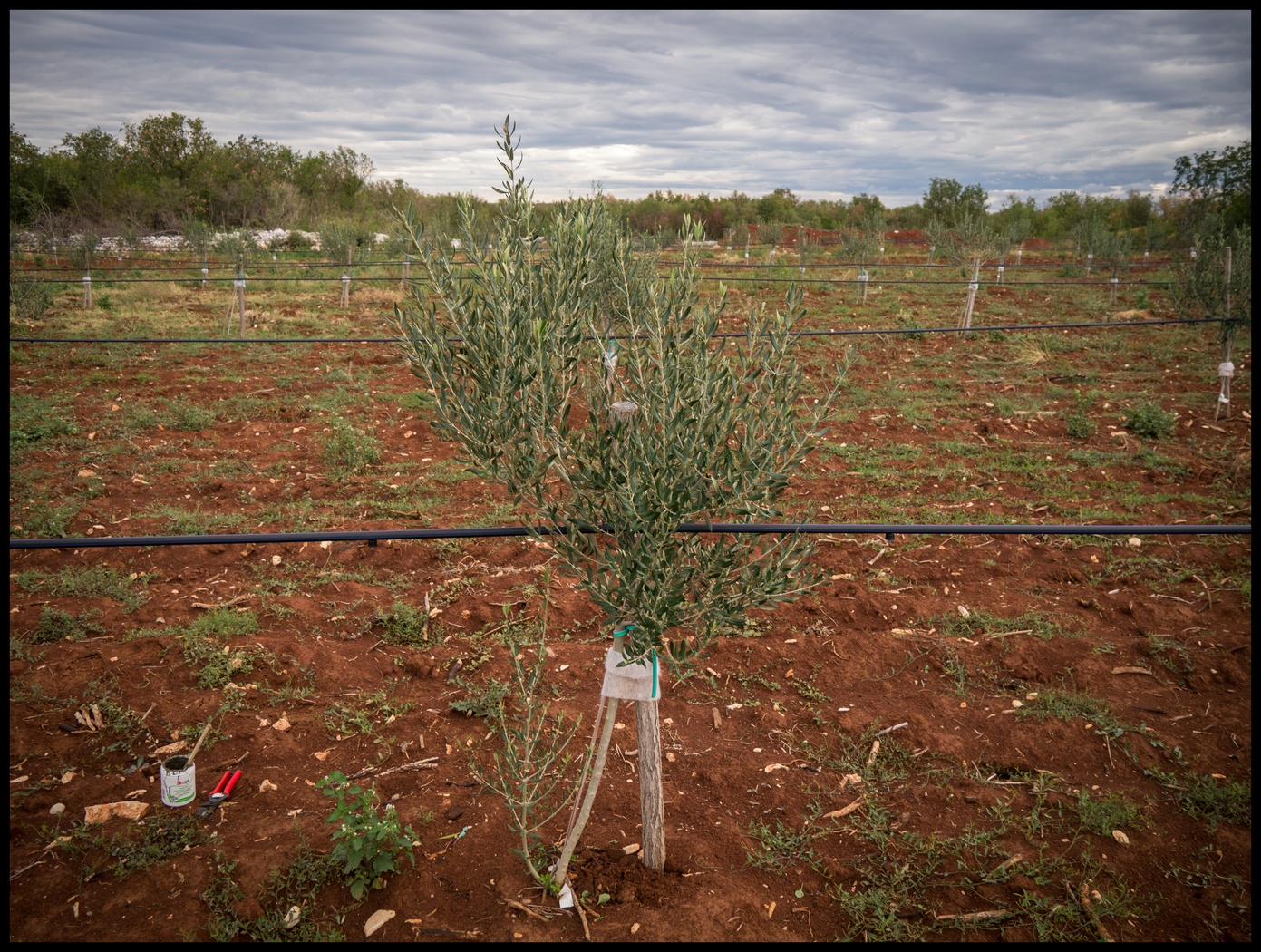
Whilst waiting for the olive fruits to reach the perfect stage for picking, the work in the orchards never stops. One of the things that demand attention at the moment is the preparation of the young orchards for the upcoming winter. Humidity and strong winds may take their toll on the still not fully developed plants, therefore the need to prune the young trees.

The benefits of such activity are various: by opening a bit the branches, more air is allowed to circulate and thererfore smaller the chances of fungi infections (some info on the main troublemaker here). Another positive point is that less sail area lowers the chances of strong winter winds tearing apart  branches or the whole tree top. Lastly, we need to start and form the olive tree top in a multiple cone (that's a huge topic to discuss...).

Anyway, it's easier to understand when seen, so here are some pictures:

As you can see, there's a branch developing at ground level (we do not want that), and the tree top is a bit busy


After the haircut


Here we have an obvious imbalance, with one of the side branches taking over


As you can see here it is almost as thick as the trunk


End result


Before


After


Obviously, spending quite some time in the orchard gave me the chance to cath some pictures of the wildlife (the lower air temperature made them easier to shoot I must say)

A horn viper youngster, more info here


Obviously frightened by my presence, it hid under some vegetation


A dragonfly


And at the end of the day, I was given the chance to enjoy a beautiful sunset:


Tuesday, 11 September 2012

Heavy artillery

Well, browsing through the pics for the post below I found two of them that did not fit in any post so far, so I guess we should give them the space they deserve. Ladies and gentlemen, we give you the Shermans (or Abrams?) of the insect world:

Jurassic park lookalike, isn't he/she?


I wonder if the intention was joining the air forces...

Orchard residents

Ok, this may already be a bit of a deja vu, however I'm still impressed by the number of insects which make theirs a landscape if the same is left insecticide-free. Maybe the widest array of shapes and colours belong to the spider world:

Should we call him pinky?
Another fan of bright coloured dresses...
This one reminds me of a three piece suit englishman
 
            
Any Rorshach fans around?


It must be said, grasshoppers also come in some great shapes and colours:


Is this all? Well, If you are still interested here are some more shots of our other residents (well, the ones that let me take a portrait, actually...):