Been missing us? Sorry but at the moment we're in "all hands on deck mode" as it's pruning season! Take a look at the short video we made (actually worth one hour of pruning) to get an idea of how's life in Cadenela orchards right now...
Pruning is probably the most labour intensive activity (or at least on harvest level) and is necessary to have a healthy and productive orchard. Oh, and the trees look better after a haircut too :-)
Showing posts with label olives. Show all posts
Showing posts with label olives. Show all posts
Saturday, 11 April 2015


Monday, 16 June 2014
Olive orchards in the moonlight
Summer's here, and in full swing too. Since it was a full moon few days ago, I decided to take a late evening stroll in the orchards (it's quite warm already here in Istria!).
Passing from one orchard to the other, I was thinking about the people who used to work them in the past days, and how were the nights they would spend in the casitas (or kažuni) when late work, or bad weather, kept them in the fields overnight. A small digression here - the casita is a small stone building, usually integrated in the stone walls surrounding the fields of southern Istria (mainly). I suppose there are thousands of them in the area, as almost each field had one...
So, I tried to recreate a semblance of life in them, and these are some preliminary results:
I like to think that the olives enjoy some human company, and who knows, maybe the fields, and the stones themseves do too?
It was a nice stroll anyway, and I almost forgot, our olives are working hard on your next oil!
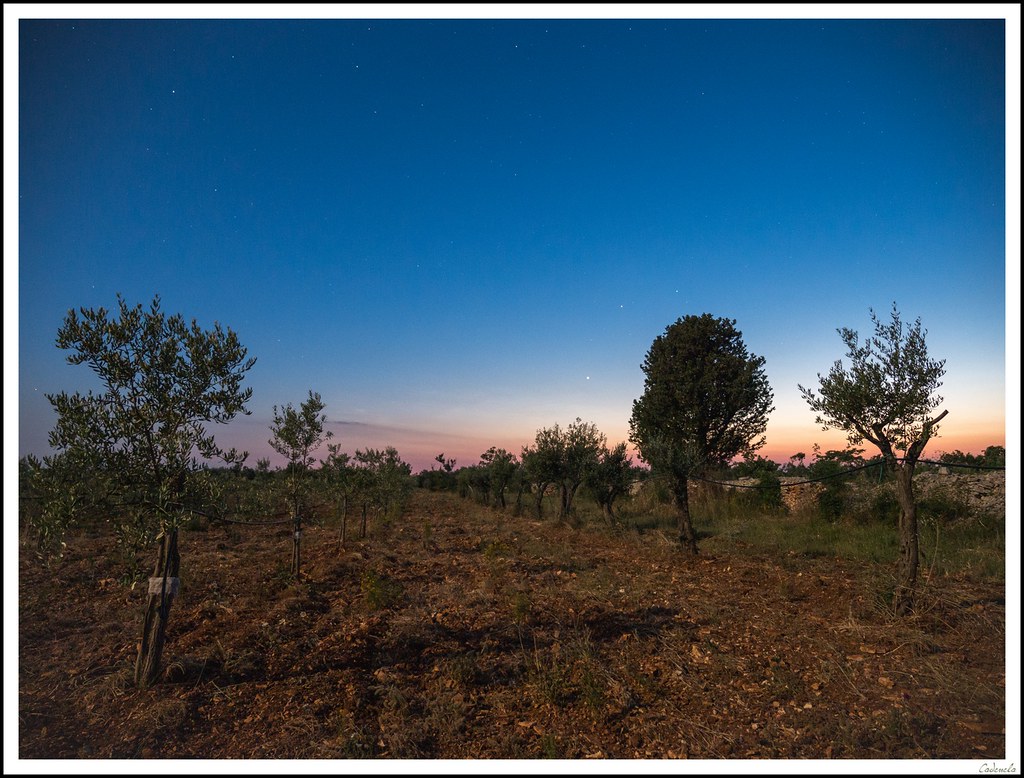 |
| Dusk in the olive grove near Dignano (Vodnjan) |
Passing from one orchard to the other, I was thinking about the people who used to work them in the past days, and how were the nights they would spend in the casitas (or kažuni) when late work, or bad weather, kept them in the fields overnight. A small digression here - the casita is a small stone building, usually integrated in the stone walls surrounding the fields of southern Istria (mainly). I suppose there are thousands of them in the area, as almost each field had one...
So, I tried to recreate a semblance of life in them, and these are some preliminary results:
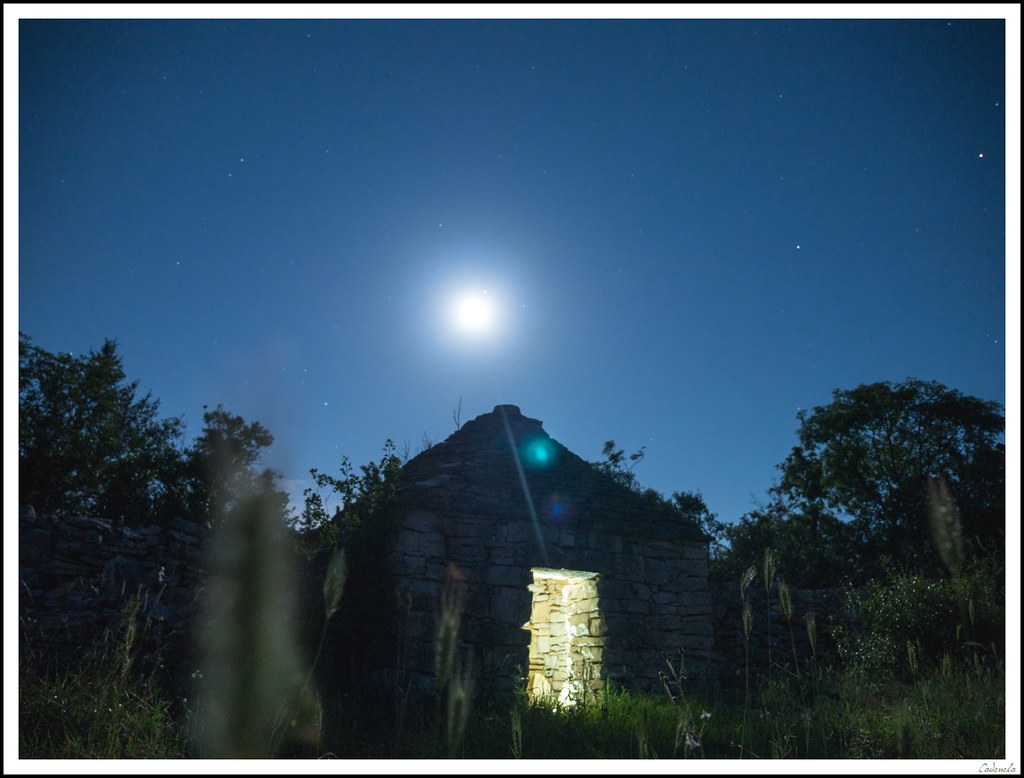 | |||||||||||
| A casita close to Peroj, in the moonlight |
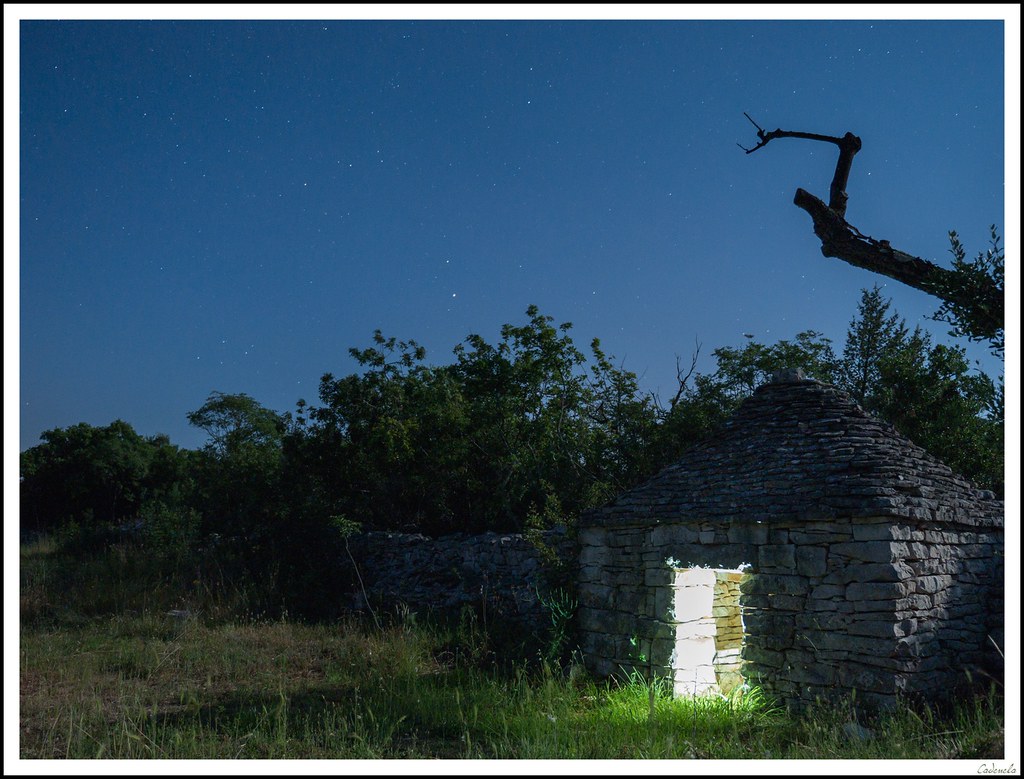 | |||||||
| Did it look like this, two hundred years ago? |
Monday, 30 September 2013
A forgotten tale
Past lives and stories have always had a special charme to me. An old letter, a path in the fields covered by growth, a roman ruin. If one looks hard enough, it is too easy to notice all the signs of days gone by, of hard work and dreams.
Sometimes they are exposed, standing so clear to remain unnoticed, obvious, and sometimes remain veiled and ask for a second look, and a second tought. In this angle of the Mediterranean, where hands have shaped, reshaped, covered and unearthed many layers, the shifts to city life of the past decades has allowed the nature to regain control of landscapes long held by man. I'd like to take you to such a place.

On our usual summer sailing route there's a well protected bay we like to stay - clear water, not much crowded, with a nice restaurant a short walk through the woods.

There's an almost hidden path that takes you from a small pier at the end of the bay to the restaurant - at first glance one does not take notice of it, as the eyes get slowly accustomed to the dim light filtering down the pine tree woods.

Walking through the quite thick undergrowth, something familiar but not easily definable starts to intrigue me - there's something in this forest that does not fit. Step after step, it suddently becomes clear: we're walking through an olive orchard! In between the slender pines and cypresses, the contorted grey olive logs now show themselves to my eyes, concious of the double nature of their surroundings.

The walk now takes a completely new dimension, and becomes a walk through time - what is now a thick pine forest, in days gone by used to glow of the silvery green nuances of the olive leave.

Grey, fossilized like old bones, the reminders of a different landscape and of the people that created it, the olives accompany you on a summer's eve walk, like roman milestones indifferent to their forgotten purpose.
Then, if you did not wonder off the beaten path, you may see this signal

which quickly reminds you of the reason you took that walk altogether - and believe me, it won't disappoint you - if you're into grilled fish or lamb. It's a bit rustic and unrefined, but with a lot of soul.
Sometimes they are exposed, standing so clear to remain unnoticed, obvious, and sometimes remain veiled and ask for a second look, and a second tought. In this angle of the Mediterranean, where hands have shaped, reshaped, covered and unearthed many layers, the shifts to city life of the past decades has allowed the nature to regain control of landscapes long held by man. I'd like to take you to such a place.
On our usual summer sailing route there's a well protected bay we like to stay - clear water, not much crowded, with a nice restaurant a short walk through the woods.
There's an almost hidden path that takes you from a small pier at the end of the bay to the restaurant - at first glance one does not take notice of it, as the eyes get slowly accustomed to the dim light filtering down the pine tree woods.
Walking through the quite thick undergrowth, something familiar but not easily definable starts to intrigue me - there's something in this forest that does not fit. Step after step, it suddently becomes clear: we're walking through an olive orchard! In between the slender pines and cypresses, the contorted grey olive logs now show themselves to my eyes, concious of the double nature of their surroundings.
The walk now takes a completely new dimension, and becomes a walk through time - what is now a thick pine forest, in days gone by used to glow of the silvery green nuances of the olive leave.
Grey, fossilized like old bones, the reminders of a different landscape and of the people that created it, the olives accompany you on a summer's eve walk, like roman milestones indifferent to their forgotten purpose.
Then, if you did not wonder off the beaten path, you may see this signal
which quickly reminds you of the reason you took that walk altogether - and believe me, it won't disappoint you - if you're into grilled fish or lamb. It's a bit rustic and unrefined, but with a lot of soul.
Monday, 11 March 2013
Of clouds and pearls
As the winter begins its retreat, more and more numerous tiny signs of the incoming spring make themselves visible around the countryside. A flower here and there, the birds' chirp becoming melodic rather than absently atonic, life in all its facets slowly waking up.
One should however not discard winter's strengths and its abrupt comebacks, as we have witnessed these days:

A dense, thick fog intermitted by rainshowers made for an, again, hardly useable period for much overdue works in the orchards. One cannot however work against nature so, walk instead of work it was.

Not all is that grey though - as I said earlier nature is slowly waking up, and early spider webs made for a beautiful rest place for the fog and its tiny water drops.

One should however not discard winter's strengths and its abrupt comebacks, as we have witnessed these days:
A dense, thick fog intermitted by rainshowers made for an, again, hardly useable period for much overdue works in the orchards. One cannot however work against nature so, walk instead of work it was.
Not all is that grey though - as I said earlier nature is slowly waking up, and early spider webs made for a beautiful rest place for the fog and its tiny water drops.
Wednesday, 23 January 2013
Small talk, big arguments
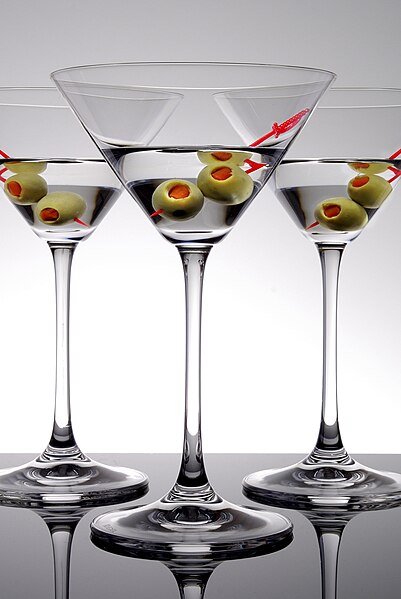
Why don't you try with some olive facts, next time you sit with an acquaintance of yours, sipping a martini, and looking at that olive floating around, thinking about starting a weather conversation?

Like:
- that olive oil is the only oil obtained from a fruit?
- that it is the only oil that can be obtained just by pressing the fruits, without need for any refinining?
- that its trade was regulated at least since Babylonian times, i.e. 5000 years ago (Hammurabi's Code bearing the first references)?
I have many more, if we ever meet for a martini, I'll share them in person...
P.S. Speaking of martinis, drink responsibly! (Sorry J, I'll make it up to you next time)
Like:
- that olive oil is the only oil obtained from a fruit?
- that it is the only oil that can be obtained just by pressing the fruits, without need for any refinining?
- that its trade was regulated at least since Babylonian times, i.e. 5000 years ago (Hammurabi's Code bearing the first references)?
I have many more, if we ever meet for a martini, I'll share them in person...
P.S. Speaking of martinis, drink responsibly! (Sorry J, I'll make it up to you next time)
Monday, 12 November 2012
The olive autumn
As one would expect, autumn brings a certain slowdown to the activities in the orchard, however not of the magnitude that would ensure a boring time to yours truly. The plants are still growing and pruning is still on the to do list, and there is a number of other things that need to be taken care of. Therefore I am quite neglecting to update you in the last few days, but here is part of what I promise to give you in the forthcoming days and weeks:
- an insight on the wind influence on the young plants
- a report on our latest try to minimize the negative influence of the insects I've been speaking about here
- some statistics and a field report on another enemy of ours
- last but not least, a preview of our logo, bottle, and label(s)!
Stay tuned!
Friday, 26 October 2012
A harvest day
In the old times, speaking of olive harvest would bring to memory pictures of cold, wet, windy winter days spent picking olives either from tall tress, balancing on wooden ladders, or back-aching bent over the ground to pick the fallen ones. Frozen hands, painfully sensitive ears and noses tickled by the thin branches and hardened leaves.
As all things in life develop and change, so did also the logic of cultivation of olives and production of oil. No more tall trees to allow crops to grow in their shade, or late harvest to achieve the highest oil percentage at the mill*. The trees are kept lower to ease hand picking, and the olives are picked at the best time that enables to maintain the polyphenols high and produce the best quality olive oil.
Last Sunday was a truly beautiful autumn day, quiet and peaceful, one could almost feel the nature preparing for the winter rest and soaking up the last sunrays reminiscent of the summer. The night humidity deposited a thin layer of pearly droplets on the grass, leaves and fruits, so we had another coffe waiting for it to dissolve. Nets were then laid around the olives, and the harvest begun.
Harvest done for the day, now fast to the mill!
*That is technically not correct. Olives picked later (i.e. after the optimal period) do give a higher percentage of (lesser quality) oil, but this is because the olives have lost in weight due to several factors like transpiration and others...It also costed less to the farmer, as you pay the mill a certain amount per kilo of olives, not per litre of oil produced.
As all things in life develop and change, so did also the logic of cultivation of olives and production of oil. No more tall trees to allow crops to grow in their shade, or late harvest to achieve the highest oil percentage at the mill*. The trees are kept lower to ease hand picking, and the olives are picked at the best time that enables to maintain the polyphenols high and produce the best quality olive oil.
 |
| Morning in the orchard |
 |
| Branches bent by the weight of the fruits |
 |
 |
 |
| Somebody having fun on the net... |
 |
| The literal fruits of one year's work |
 |
Harvest done for the day, now fast to the mill!
*That is technically not correct. Olives picked later (i.e. after the optimal period) do give a higher percentage of (lesser quality) oil, but this is because the olives have lost in weight due to several factors like transpiration and others...It also costed less to the farmer, as you pay the mill a certain amount per kilo of olives, not per litre of oil produced.
Wednesday, 3 October 2012
Harvest time approaching
In between the frequent rainshowers that are passing by with the regularity of the Heathrow Express, exept for the standard checks of familiar flora&fauna inhabitantas of the orchards, a new topic is more and more becoming subject of our attention. Harvest season is approaching fast and we need to keep track of the olives starting to ripe, in order to pick the exact time for harvest*. As with probably every other thing, one should not be too quick to act or delay too much the decision to pick the olives. The earlier cultivars (i.e., the ones that tend to ripe sooner) started to change colour. Since this year's harvest will be quite meagre, there's no chance of picking each cultivar separately and producing monocultivar olive oil - it will have to be a cuvee. Not that it's a bad thing per se, will just have to time the harvest a bit more precisely.
Here are some of the leccino fruits already starting to change colour:
Here is another grouping of leccino cultivar, with one olive (yes, the one a bit out of focus at 7 o' clock...) just about to start its dress change:

It is a matter of days now. Will keep you updated.
*That's a specific topic altogether, an is subject of a fervent, almost religious discussion, by followers of different schools. As almost always the old latin "in medias res" is true, probably there's a middle way in this topic too. Will elaborate in detail soon.
Here are some of the leccino fruits already starting to change colour:
 |

It is a matter of days now. Will keep you updated.
*That's a specific topic altogether, an is subject of a fervent, almost religious discussion, by followers of different schools. As almost always the old latin "in medias res" is true, probably there's a middle way in this topic too. Will elaborate in detail soon.
Friday, 15 June 2012
The wild olive trees of Sardinia
Back from one trip, and ready for another one (it's travelling June this year), I wanted to share some insights I missed during my previous visit of Sardinia.
Should you ever decide to visit this still wild gem of the Mediterranean, try for a few moments to skip the beautiful beaches and head for some less populated and known spots - the island is willing to show so many different facets to the traveller with the time and will to see, grab and observe them.
As my personal penchant and theme of this blog are the olive tree and its fruit, it doesn't take a wild guess to know what continuously grabbed my attention: along winding roads, on top of mountains as well as along beaches and coves, the wild olive is the quiet and understated background of any Sardinia's sight. The beaches may glow with their turquoise colours or the sanguine rocks impress you with their weird shapes, but there will always be the silver reflection of the olive leaves somewhere in the background. It's like the double bass in a jazz band...
As it has been said that a picture is worth a million words, I'll stop here and let you see what it's all about:
Friday, 25 May 2012
Weekend olive links
As it happens, having some useless facts up in one's sleeve can sometimes come in really handy. Given the nature of this blog, the topic of said useless facts will of course be olive oil.
I suppose a general read from the most beloved fast-food of facts should be a good place to start: Olives article on Wikipedia
I also happen to be a mythology junkie, so I suggest you take a look at this myth about the olive tree (there's also an audio file for the really lazy)
And, I guess this should be appropriate, what is exactly extra virgin olive oil? (maybe not that useless...)
+++
For the less inclined to chemistry and long explanations, the extra vergine is obtained by cold pressing freshly picked olives. That's it.
The free fatty acids number (which should be below 0,8%) is basically an indicator of how much care was taken for the fruit and its transformation into oil. The other marker in use, the peroxide number, tells you how "rusty" the fats are. Here too, the lower the number, the better the oil. A broader explanation on olive oil chemistry here.
+++
Or, if the weather serves you well, you may rather want to go out and enjoy yourselves and keep those links for a boring rainy/working day.

Subscribe to:
Posts (Atom)